Editorial
Tales of Perseverance
In 1985 Simon Yates and Joe Simpson successfully reached the summit
of the West Face of Siula Grande in the Peruvian Andes. On their descent
they ran into serious problems. Joe slipped and broke his right leg.
Clearly, this was to make the descent very difficult indeed. Simon
did his best to lower Joe off the North Ridge, but with storm conditions
prevailing and darkness descending, Simon accidentally lowered Joe
off a cliff. He could feel the whole weight of him on the rope but
of course Joe could not climb up and Simon could not pull him back
up. After considerable effort and deliberation, Simon cut the rope.
Joe, by now suffering from hypothermia, plummeted down the cliff and
into a deep crevasse. Simon descended the mountain but on reaching
the crevasse, realised the gravity of the situation and naturally
assumed that Joe had died. In fact Joe had survived the massive fall
and landed miraculously on a small ledge inside the crevasse. Coming
round, he realised the rope had been cut and he would have to save
himself. Thus begun the exhausting and treacherous journey down the
mountain. Against the odds Joe reached the bottom and crawled and
hopped five miles back to base camp reaching their tent just a few
hours before Simon intended to leave. This is, of course, a grossly
simplified version of Simon and Joe’s epic tale as set out in
Joe’s gripping book, ‘Touching the Void’1. It is
an outstanding representation of the important quality of persistence
without which little can be achieved. And in some extreme cases, such
as the one recounted, lives depend upon it.
Bosham House News
Wildlife Pond and Bog Garden Project – We need your help!
Thank you’ to all you lovely people who have made love offerings
towards this important Project. This will add an important feature
to the Bosham House grounds and allow us to make greater provision
for our wildlife and, indeed, encourage wildlife. Do please keep sending
your love offerings because each one brings us that much closer to
creating something of lasting beauty. The fund currently stands at
£1, 326.53.
Member, Sheila Ward, is looking for reading groups and offers her
book free of charge
In the last issue of ‘New Vision’ we published an article
by Sheila Ward entitled: ‘Beauty as a Gateway to something Beyond’.
In the introduction Sheila mentioned the second edition of her book
‘Towards Wisdom - Elders exploring life experience to create
a future of hope’. She is now looking for reading groups of
elders who would be prepared to read and consider the book, especially
in relation to the meaning, variety and significance of love. She
will send books free of charge in packs of five or six or more. If
you can help please email Sheila: sophiatree.co.uk or telephone: 01305
261 905.
New Vision Light Workers
A small, varied group of like-minded people who share a desire to
spread Light, Love and Healing to the world and to each other.
We meet on the second Saturday of each month in the library at Bosham
House from 10.30 am to 12.30 pm and are always happy to receive new
visitors. One of our members recently made the following comment:
‘I just know that it is a wonderful space for me to be in and
for us as a group to put some good back into our world.’ Please
feel free to come along and experience the group for yourself, there
is no obligation but you never know – it might be just what
you are looking for!
The dates for 2012 are as follows:
7th January, 11th February, 10th March, 14th April, 12th May, 9th
June, 14th July, 11th August, 8th September, 13th October, 10th November,
8th December.
Readers' Letters
We continue to welcome your letters and emails. If you have a comment
on an article or a suggestion to make, why not share your views with
others. Please write to the editor at Bosham House, Main Road, Bosham,
West Sussex PO18 8PJ or email elizabeth@thehamblinvision.org.uk
Dear Elizabeth
Enclosed is a cheque for my membership for 2012 and a donation to
the Festival of Light. I will be thinking of you holding that service
at noon on December 20th. It means a great deal to me that I am able
to participate in this service. It seems appropriate at this time
of year when we feel the loss of our loved ones even more keenly.
Margaret Godfrey, Somerset
Dear Elizabeth
It is with pleasure that I enclose my cheque for £21 plus a
little more. Thank you all for such a wonderful publication. It always
brings such joy and the cover photographs are superb. God bless you
all in your work.
Christine Simpson, Somerset
Holding Fast by Michael Donnelly
Letter writing is rapidly becoming a thing of the past so it is quite
unusual to have, not just one, but two letters in the post this morning.
One was from our Editor, asking me to write again for New Vision on
the subject of perseverance, and I opened my thought at once to any
useful ideas.
I did not have long to wait. The second letter, in fact, proved to
be the very thing and I know that its simultaneous arrival is no mere
coincidence. It was from a lady called Katrina Gardner, and with it
were several attractive Christmas cards which she and a number of
fellow artists have produced. Katrina was born without proper arms
due to the drug Thalidomide and has taught herself to paint holding
the brush between her toes. She belongs to a group known as mouth
and foot painting artists whose aim is to be self-supporting from
the sales of their work.
As I placed these two letters side by side I was reminded of something
written by our founder, HT Hamblin, many years ago. I have all his
books on my shelves and (another ‘coincidence’) I found
it in the first one I opened entitled The Open Door.
We need constantly to remind ourselves that we are not studying our
spiritual textbooks as an exercise in wishful thinking but in the
sure knowledge that our steadfast dedication to their teachings can
make a real contribution to the general good. Mr Hamblin never claimed
to have lived up to the challenge of his highest writings but, in
him and other seers like him, we have guides we can confidently follow
with joy and profound gratitude.
What a Delight our British Wildlife Is by Graham Cole.
Being a volunteer at Brent Lodge has, for me, been a terrific, satisfying
experience and one I intend to continue for a long time – volunteers
are always needed.
At Brent Lodge Wildlife hospital at Sidlesham, near Chichester,all
manner of birds and other creatures are looked after, brought in by
caring people who are as fascinated as I am by the charm,beauty and
vulnerability of these animals.
Brent Lodge is primarily a hospital, but also has a few long-term
residents such as Oscar and Lyle – to find out who and what
they are, you will have to pay us a visit!
At the time of writing, in mid-November, we are inundated with hedgehogs.
This is a normal situation as winter draws near. They are too small
or too young to resist the rigours of winter and would be unable to
survive hibernation. At Brent Lodge they have a cosy place to live,
excellent food supplied by well wishers and beds of shredded newspaper.
Everything is changed on a daily basis and there is excellent health
care. Not for them worries about paying fuel bills or feeling chilly!
As well as the hedgehogs, lots of birds come through the hospital’s
doors. In fact birds make up the majority of our patients (yes, that
is what we call them!) Total patient numbers exceed 3000 per annum,
of which approximately 2300 are birds, 600 hedgehogs and the rest
are mainly other mammals such as rabbits, foxes,deer, the occasional
badger and miscellaneous others.
The Gift by Mary Spain
My Bengal Cat, Chloe, is a registered Pets As Therapy cat. She comes
with me on weekly visits to our local nursing home. Although I had
been told a good deal about the therapeutic benefit of animals, it
struck me recently that there is one benefit that is rarely, if ever,
mentioned. Think about it for a moment. You are aware of the ubiquitous
background noise of the vacuum cleaner, the squeak of wheel chairs
in motion, nurses' quick feet hurrying down the passages, water running
in the basins, the occasional voice… but you rarely, if ever,
hear the sound of laughter.
This is the gift that Chloe, in her innocence and exuberance, brings
on every visit. Each time she enters a resident's room the tired,
unfocused eyes of the occupant light up with sudden interest.
‘May Chloe come and visit you?’ I ask, and the welcoming
face grows pink with pleasure.
The chuckles start as she begins her enthusiastic examination of the
room and its contents: the books on the bookshelf, flowers on a table,
the view from the window. An unexpected pigeon in the garden below
can be a cause for general excitement!
Perseverance is a State of Mind by Harriet Lang
Undergoing great trials and tribulations, seeing something through
to the bitter end, or surviving against all odds are what we often
associate with perseverance. But, it can really just as easily be
applied to everyday activities, work and commitments. How do we maintain
peace of mind and contentment in enduring all the mundane and repetitive
aspects of normal daily life?
It takes perseverance to appreciate the ‘heart’ present
in daily activities such as cleaning and cooking and going to work
each day. All of these tasks we do out of love both for ourselves
and for our families but when we resent them or don’t value
their place in our lives, we do ourselves a disservice. We don’t
value our input and efforts into these fundamental building blocks
of our lives. They form the structure of our day and of our home,
almost like a skeleton or scaffolding and, without them, we may become
lost or all at sea without routines or practices to bind us into a
coherent whole.
Four Paws and a Funeral bu Suzannah Stacey, BSc, BVM&S, MRCVS,
Cert. Vet.
Acu (ABVA)
This month I was somewhat taken aback when I kept a regular appointment
with Ann Ford, a long standing client whose dog suffers from arthritis,
only to find when I arrived at her house that it was full of strangers
and the noisy hubbub of conversation flowing throughout the rooms.
Steering me towards the kitchen, Ann explained that she was having
a wake for her brother-in-law that afternoon, but she didn’t
want to re-arrange my appointment as the dog was in need of his treatment.
The dog, Henry, was lying calmly in his usual resting place underneath
the kitchen table, where he invariable receives his treatment once
I have checked for any changes since my last visit. Usually, a welcome
cup of tea is offered at this point, but today was special and a glass
of sherry suggested – under the circumstances I thought it best
not to join in with that particular tradition. The entire kitchen
was bedecked with various delicious food morsels too, much to Henry’s
delight as he waited for various inebriated guests to sneak some tasters
in his direction. A few family members, passing through the kitchen
area were introduced and expressed an interest in staying to see Henry
being treated, but in truth acupuncture is not really a spectator
sport, as the needles take seconds to insert and Henry usually sleeps
through the whole process, so those few who gathered drifted gently
off in search of more exciting conversations and edible fancies. Focusing
on Henry, I let the ebb and flow of people and conversation flow around
us, leaving us marooned on an island between the four legs of the
table. Once his treatment was over, I rejoined the milling relatives
and went in search of the host, to take care of the paperwork and
arrange Henry’s next visit.
A Spider's Wisdom by Murray Morison
The cave was cold, windy and forlorn, or so the story goes. The man
was hunted and there was a high price on his head. Outside the cave
the wind whipped past and a dull, grey light hardly illumined the
perpetual drizzle. He watched as the clouds and mist alternately revealed
and hid the wet hillsides in the distance. Nearer at hand a movement
caught his eye. A spider.
It was quite large, the sort you would not wish to find within your
bedding. It turned slowly in the damp breeze and climbed up its own
ultra-fine gossamer thread. Nearing the cave ceiling it began to find
a new spot to attach its web but a gust of wind dislodged it and there
it was, spinning just where it had started.
The man watched as once more it began its assent. And then fell again.
Time after time the spider climbed and time after time an unfriendly
swirl of wind would return it to the very end of its own thread.
Raibeart, for that was his name, listened for the sound of men and
horses that would show his hiding place had been revealed. He knew
Edward would use every means possible, including torture, to find
him and execute him as he had William Wallace1. Raibeart had been
crowned King of the Scots but the English King did not accept his
legitimacy and had defeated him in battle. He had fled and was now
in hiding.
My special mother, Lilia, – an exceptional life well-lived
by Mariana Van West de Veer
My mother, Lilia Van West de Veer-Tieffenbach, was a member for many
years. She has kept many copies of The Science of Thought Review (now
New Vision), which I now have inherited.
My beloved mother had a very interesting, challenging, long life.
She passed over on 4 July 2011 at almost ninety nine years of age.
I would like to share with you more about her life. Lilia was born
on the 24th September 1912 in Berdiansk, Russia from a Swiss father
and a French mother. Because of the Russian Revolution in 1919 she
was obliged to flee to Istanbul with her parents and sister. Subsequently
my mother moved to Nice then to Casablanca and after finishing the
Lycée she and her sister were sent to London to Pitmans School.
There she met my Dutch father who was studying law in Utrecht. In
1937 they married in Casablanca and went to Batavia Dutch Indies where
my father worked as a lawyer.
During the Second World War my father was captured by the Japanese
and taken to Fukuoka on the Japanese island of Kyushu, where he had
to work in a coal mine. My mother,brothers, Robert and Peter, and
myself were put in a concentration camp (Tjideng). Needless to say
that these years of starvation, sickness and fear were a terrible
experience. When we were liberated after the bombing of Hiroshima
and Nagasaki, we were taken to Morotai Island (N. of Halmahera), where
we met our father.
There my brothers and I were baptised by a military Protestant chaplain.
We returned to Europe, but first spent one year in Casablanca with
the family of my mother in order to forget the bad years in the camps.
Since 1947 we have all lived in The Hague. My father died in August
2006, my brother Peter, in March 2010, his wife in June 2010, and
my mother on 4 July 2011 .
Gardening Matters by Sue Attridge
It has been an extraordinary autumn with mild conditions still prevailing
as I write in mid-November. In one of the flower beds, a delphinium
is sporting a proud head of buds which are on the point of opening.
That's exceptional in itself; what adds to my pleasure is that the
peafowl have left them untouched. (Perhaps those they ravaged in the
summer disagreed with them.) Everyone has stories of plants still
flowering in their gardens, grass still growing and birds being duped
into thinking it's time to nest again. We know it can't last much
longer, but the memory of the last two winters keeps us (certainly
me) enjoying these unusual temperatures.
Raking up the leaves is a bit of a chore, especially as the trees
keep up their gentle bombardment for many weeks; but there's treasure
under the leaves! This long autumn has encouraged an amazing proliferation
of fungi. I've never seen so many – and of so many different
types. One of our regular volunteers, Angie, knows a thing or two
about fungi and seems to find different ones every week (some of which
she confidently takes home to eat). The most unusual one she spotted
was a type of stinkhorn, (the latticed stinkhorn or red cage) which,
when it erupts, produces a surprising orangey-red honeycomb structure.
The slime inside does indeed smell vile but, as most of us don't spend
too much time prostrate in the leaf litter, we can delight in this
transient marvel. One of my favourite fungi is the classic fairy tale
toadstool, fly agaric, its large red caps spotted with white, which
I've found only in the area between the tulip tree and a neighbouring
silver birch. However, around the grounds there are several patches
of grass studded with numerous small discs, yellow, orange and brown,
glistening in the sun like coins, as beautiful as the violets and
primroses which took my breath away in the spring.
Finding Christ Consciousness by James Ashby.
As the Gospels report, Jesus said ‘I am the bread of Life’.
His actual words in our own language, however, were ‘I the bread
of Life’ since the verb ‘to be’ is assumed, not
said or written in Hebrew and Aramaic.
As the Gospels report, Jesus said ‘I am the bread of Life’.
His actual words in our own language, however, were ‘I the bread
of Life’ since the verb ‘to be’ is assumed, not
said or written in Hebrew and Aramaic.
There is a further translation to be considered, since in Jesus’
language the word for ‘bread’ is the same as the word
for ‘insight’. In Aramaic ‘Lachmo’ has both
meanings. Jesus would know, as he taught the people, that his words
could be understood on different levels by different listeners. In
traditional Christianity we are used to hearing his words:
‘I (Jesus) am The Bread of Life’. Yet at the same time
he was saying:
‘I (Jesus) am The Insight To Life.’ And yet again he was
saying:
‘I Am (Understanding Yourself) is The Insight to Life’.
And ultimately:
‘I Am (The Divine within you) is The Insight to Life.’
In the Gospel of Thomas, Jesus had already explained that ‘The
Kingdom of God is Within You and it is Outside of You.’ In another
part of the Gospels he says that, ‘when you pray you should
go into your chamber, shut the door and be still.’ (Matthew
6:6.)
We now know from our scientists about the difference between the left
hand and right hand brain hemispheres. The left does the mental, logical,
consequential thinking bit. The right is all to do with awareness,
of form, of proportion, of love, of compassion, of creativity, all
independent of logic, and so independent of teaching, and for that
matter independent of the restrictions of the physical and mental
world.
Commitment from the Heart by Jasmine Carter
Having a friend who is an inventor, I see his perseverance in action
on a daily basis. Most of his inventions are for the medical profession
in the form of machines and gadgets to help them with quite complicated
procedures. I observe the importance of meaning, purpose and commitment
in his life. He’s determined to succeed in his aim but with
flexibility, enthusiasm, lightness, focus and patience – I see
so many special qualities in his approach.
He’s an electronic engineer by profession and is highly creative.
A problem isn’t a problem for him – it is a learning curve
and he says that he learns more from mistakes than anything else.
He learns what not to do next time!
His nature is gentle, he has an exceptional mind and he loves to learn.
He enjoys talking to people and is a very good listener but he walks
around everywhere with a pencil and notepad so that he can jot down
any ideas that might suddenly come to him.
He also knows how valuable quiet moments are when he is walking his
five miles a day or having his leisurely breakfast before starting
work in the laboratory at home – he is never really off duty,
and has no need to be, as he enjoys inventing. It is like a way of
life to him.
Perseverance is Needed in Every Worthwhile Endeavour by Peggy Lance
Little
Around 1970, a book called The Structure of Scientific Revolutions
(Thomas Kuhn) was published that outlined the stages of development
of any new scientific theory. Up until that time it was thought that
scientific knowledge was cumulative, each new increment of knowledge
or discovery was cemented into the existing framework of an already
robust set of facts about the world. This book rather upset the apple
cart by showing how a new theory or new discovery about something
was ridiculed in the scientific journals, their authors shunned and
pushed to the sidelines for years. Then, at some point, one or two
professionals in the field began to review the idea until a few started
writing about it. Finally, the idea was accepted to such a degree
that it seemed to always be a part of that body of scientific knowledge.
This process which was shown in the book happened in every single
major breakthrough in science. New ideas took years to be accepted.
What if the individual scientists gave up or were sufficiently discouraged
to take other jobs outside their field? It is those who persevered
in the face of mounting ridicule that prevailed. Another book called
Outliers, showed that to be proficient in your chosen field you need
to spend 10,000 hours at your craft.
Bosham House Bee Bulletin by Jan Jenkins
The bees at Bosham seem to have coped well this year despite the fluctuating
temperatures and unseasonal weather but, as was the case last autumn,
there is no surplus honey. All the honey that the bees have produced
has been left in the hive for their own consumption over the winter.
When the hive was ‘hefted (weighed) in late September and the
calculation of the ratio of bees, comb and stores was assessed, I
judged that given the high temperatures and good forage, the bees
would make up the small amount of extra stores they would require
to winter successfully.
When the hive was ‘hefted (weighed) in late September and the
calculation of the ratio of bees, comb and stores was assessed, I
judged that given the high temperatures and good forage, the bees
would make up the small amount of extra stores they would require
to winter successfully.
The well-being of the bees is of primary importance and there are
many variable factors that contribute to a healthy, thriving colony.
Looking Beyond by Sheena Whorlow
What immediately came to mind with the word Perseverance was the legend
of Robert the Bruce. Hiding away in his cave from the English, almost
ready to give up, he watches a tiny spider trying desperately to spring
himself from one part of the roof to the next. The spider dangles
from a long piece of web and is swinging himself backwards and forward
trying to reach his destination. At last on the seventh try he makes
it and disappears into the darkness. This is the turning point for
Robert the Bruce. He feels that if the spider can persevere to such
an extent so can he, and on his seventh try, reclaims his native Scotland
from the English.
A wonderful little tale of dogged perseverance from both the spider
and Robert the Bruce, but I wonder where does perseverance end and
stubbornness take over? It strikes me that we need to be a little
stubborn to maintain our perseverance but there are times when stubbornness
is futile. At such times we have to recognise that the path we may
have taken is not quite the right one for us. It does not mean we
have failed it just means we have had the sense to see that perhaps
a slight deviation on our path is necessary to get us where we want
to be.
In the Face of Adversity by Rosalind Smith
As the days begin to shorten the number of bees within the hive will
diminish from their peak of about 55,000 at the height of summer,
to an ideal of about 20,000 for the winter.
Bees born at this time of year have a slightly different metabolism
to the summer bees; they have a greater capacity for storing fat which
enables them to overwinter successfully and their life span extends
to about six months. This is in marked contrast to the busy summer
bees that spend three weeks in the hive and then forage for two to
three weeks, literally wearing out their wings, to end their lives
after only five to six weeks.
Journeying Adventurously by Andrew Dean
In the early 1920s, my grandmother had to watch the bailiffs while
they took away her piano, her main means of support as she was a music
teacher. She had got into debt. Her husband had died due to some long-term
health problem resulting from the war; she had five children under
ten to house and feed and this was a time when there were no benefits,
no National Health Service, none of the help that people expect these
days. Possibly the only ‘help’ there was, was to be sent
to the poorhouse, usually a pretty grim fate.
This was typical of many people, especially women, of her day. And,
we must remember that they had none of the ‘mod-cons’
that we have nowadays – no washing machines, no fridges, no
central heating, no radio and TV. And often their families were large,
because of the lack of understanding of, and access to, birth control.
So there would be many children filling the often limited household
space, and spilling out onto the streets and yards outside.
So, how on earth did they cope? Well, it must have only been possible
with a great deal of perseverance. Keeping on relentlessly, scraping
a living as best they could, making and mending, making ends meet,
going without basic foodstuffs. Life must have been very tough and
miserable for many. And yet, they brought their children up, and they
sent them out into the world, often to become worthy and valued members
of society.
Interview with Clare Dakin, founder of TreeSisters ~ a new women’s
movement to accelerate global reforestation and the shift to sustainable
living.
Elizabeth: Clare, many of us have not come across
TreeSisters. What is it and what is its core purpose and message?
Clare: Thank you for this opportunity to share, and
for your interest! TreeSisters is a new campaign that aims to explore
the role that women can collectively play in bringing about a more
appropriate response to climate change. Specifically we are addressing
the imbalanced way that we take from the planet without thought for
consequence; how we destroy the forests that cool us, while pumping
out the Co2 that warms us. Our core purpose is to bring about swift
global reforestation by making it normal for everyone to give money
for trees every month to start balancing our taking and our emissions.
Our message is an invitation for women to help bring about the speed
and scale of shift towards sustainable living that is needed to secure
a safe future for our children.
Elizabeth: Why is there a bias towards women and
is it just women who can be involved?
Clare: There is a bias towards women because there
is a lack of feminine leadership in this world, and because there
is a direct correlation between the diminishment of the feminine and
our current state of ecological overshoot. Patriarchy has given us
great advances in many ways that have made us extraordinarily successful.
But it has also been out of balance, leading to cultures that celebrate
competition over collaboration, mind over heart, results over experience,
money over life and science over nature. The degree of emotional disconnection
that is considered ‘developed’ in our world sees us destroying
the ecosystems upon which we depend as if sufficient wealth or technology
will insulate us from catastrophic climatic shifts and the impacts
on food and water that are heading straight for us.
Men and women have different tendencies, different qualities and different
strengths. Women’s tendencies are towards the protection and
preservation of life, towards collaboration, caretaking, sharing,
listening and exploring ways to resolve issues peacefully and to the
benefit of all. Women are the natural missing counterbalance, and
yet knowing that, and feeling able to step up and act upon it are
very different things! After centuries of being put down, many women
are afraid to shine their light or make themselves visible for fear
of some overt or covert backlash. TreeSisters is about the
development of a sisterhood that provides the support and encouragement
needed to help women to step up and offer their gifts to the world.
While this is targeted specifically towards women, we also acknowledge
that the feminine exists within men as well, and that men have also
suffered as a result of our emotionality being shamed. We are not
exclusive at all. Men are being wonderfully supportive, and are actively
finding ways of getting involved, and as we grow and expand we hope
that their involvement will also increase and find its natural place
within the movement.
Clare: If TreeSisters speaks to you and you would
like to get involved please:
• Join us by registering on the join in page of our web site,
so that you can be updated on all our progress and receive our invitations
for involvement.
• If you would like to support the development of the campaign
and become a founding funder (great or small!) please make a donation
or set up a monthly payment on the donation page on our site. We are
crowd funding our development and seeking major donors right now.
• Plant these questions in your heart: ‘How would I build
a global network of women, and inspire them to bring their gifts to
the TreeSister cause? And, what do I personally have to offer?
• Find out more about us on our website (www.TreeSisters.org)
and Facebook to discover how to get personally involved. Alternatively,
please write c/o Bosham House.
• Watch the films on our website and send them to everyone you
know, especially those that you know are looking for ways to give
back in some way.
• Love the trees, collect their seeds, create a mother bed,
grow some saplings and next year plant your own trees .
Each issue of New Vision also features a good book reviews section
If you have enjoyed these excerpts, please telephone/email Bosham
House for a full copy of the magazine. This is available through membership
or by donation.
Tel. 01243 572109 email: office@thehamblinvision.org.uk
The New Vision is published bi-monthly by The Hamblin Vision, the publishing
arm of The Hamblin Trust and is sent to all members of the Trust.
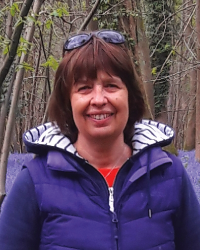
It is edited by Elizabeth Medler, shown on the left.